


The energy efficient home improvement credit can significantly reduce the after‑tax cost of upgrades like heat pumps, insulation, windows, and electrical panels when you understand the IRS rules and plan projects over multiple years. This essential guide explains eligibility, caps, examples, and filing tips so you can use Form 5695 to maximize savings under the energy efficient home improvement credit while improving comfort and lowering energy bills.
Table of Contents
Understanding the Energy Efficient Home Improvement Credit
The energy efficient home improvement credit is a federal income tax credit that lets you claim 30% of qualified expenditures for certain energy‑saving improvements to an existing home. Unlike deductions, which reduce taxable income, the energy efficient home improvement credit directly reduces your tax bill dollar‑for‑dollar up to annual limits.
Under current law, the energy efficient home improvement credit applies to qualified property placed in service from 2023 through 2032, as updated by the Inflation Reduction Act. The rules are implemented through section 25C of the Internal Revenue Code and detailed in IRS guidance, instructions, and FAQs.
Who Qualifies for the Credit
The energy efficient home improvement credit generally applies to taxpayers who improve an existing home located in the United States that they use as a residence. In most cases, the best value is for owner‑occupants using the property as their main home, though certain improvements to second homes used as residences may also qualify depending on IRS rules.
Rental‑only and new construction properties do not qualify under the energy efficient home improvement credit, although other credits may apply for clean energy systems. Always review the latest IRS FAQs and talk to a tax professional if the property has mixed personal and rental use.
How the Credit Is Calculated
Beginning in 2023, the energy efficient home improvement credit equals 30% of qualified expenses for eligible improvements, subject to both an overall annual cap and specific per‑item limits. In many cases, there is a combined annual limit of up to 3,200 dollars, made up of 1,200 dollars for most building envelope and energy property upgrades plus 2,000 dollars for certain high‑efficiency heat pumps, heat pump water heaters, and biomass systems.
Within the 1,200‑dollar portion, exterior doors are generally capped at 250 dollars per door (500 dollars total), windows and skylights at 600 dollars, home energy audits at 150 dollars, and many electrical components or HVAC items at 600 dollars per item. Planning which projects you do each year helps you capture the full 30% rate under the energy efficient home improvement credit without hitting annual limits too quickly.
IRS Forms and Lines You Need
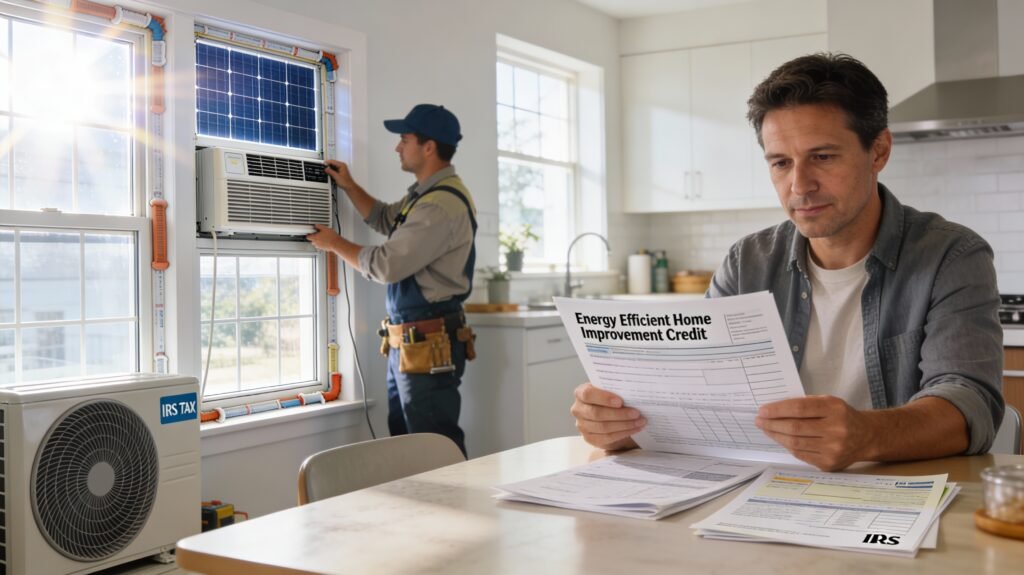
To claim the energy efficient home improvement credit, complete Part II of IRS Form 5695 and then transfer the calculated credit to Schedule 3 of Form 1040. The form asks you to list total qualified costs for each category (windows, doors, insulation, heat pumps, panels, etc.), apply the 30% rate, and then apply per‑item and annual caps.
The line numbers and layout can change over time, so always follow the latest Form 5695 instructions on IRS.gov when filing. You should retain product certification statements, invoices, and proof of installation dates with your tax records in case the IRS requests documentation for the energy efficient home improvement credit.
Example: Combining Heat Pump and Insulation
Consider a homeowner who installs an eligible ductless heat pump for 7,000 dollars and adds 2,000 dollars in qualifying attic insulation in the same year. At a 30% rate, the theoretical energy efficient home improvement credit would be 2,100 dollars for the heat pump plus 600 dollars for insulation, or 2,700 dollars total before caps.
Because qualifying heat pumps fall under the 2,000‑dollar annual limit for that category and insulation is subject to the 1,200‑dollar combined building‑envelope cap, the homeowner must check that total credits under the energy efficient home improvement credit do not exceed 3,200 dollars for the year. If the 3,200‑dollar ceiling is reached, remaining potential credit is lost rather than carried forward, so phasing work over two years may be smarter.
Eligible Improvements and Itemized Caps
Major Eligible Categories
Several major categories typically qualify for the energy efficient home improvement credit if they meet efficiency standards and are installed in a U.S. residence during the tax year. Common examples include:
- Heat pumps and heat pump water heaters that meet or exceed efficiency thresholds, often tied to CEE or ENERGY STAR criteria.
- Biomass stoves and boilers with thermal efficiency of at least 75%, up to 2,000 dollars per year in credits combined with heat pumps.
- Insulation and air‑sealing materials such as batts, rolls, spray foam, blown‑in, rigid board, weather stripping, and house wrap that meet modern energy code standards.
- Windows, skylights, and exterior doors that satisfy ENERGY STAR or ENERGY STAR Most Efficient requirements for your climate zone.
- Certain electrical panelboards, feeders, and branch circuits installed to support qualifying equipment and meeting National Electric Code requirements.
- Home energy audits performed by qualified professionals, subject to a relatively small credit cap under the energy efficient home improvement credit.
Per‑Item Caps and Special Limits
Within the 30% framework of the energy efficient home improvement credit, the IRS sets specific dollar caps per item or group. Typical limits include:
- Up to 2,000 dollars annually for heat pumps, heat pump water heaters, and qualifying biomass stoves or boilers.
- Up to 600 dollars total per year for replacement windows and skylights.
- Up to 250 dollars per exterior door, capped at 500 dollars total per year.
- Up to 600 dollars each for qualifying energy property such as certain efficient furnaces, boilers, or panels, and up to 150 dollars for a home energy audit.
Product and Installation Qualifications
To qualify for the energy efficient home improvement credit, products typically must meet ENERGY STAR, CEE, DOE, or code‑based performance standards and be certified by the manufacturer as eligible for the credit. You should save manufacturer certification statements or screenshots from product pages as proof.
Improvements must be installed in a residence located in the United States and placed in service during the tax year, not simply ordered or paid for. They must also comply with local building codes and be expected to remain in service for multiple years to support your energy efficient home improvement credit claim.
Choosing Energy‑Saving Products and Tools
Once you confirm eligibility, selecting efficient products helps you stretch both energy savings and your energy efficient home improvement credit. For example, many homeowners upgrade to variable‑speed heat pumps that offer zoned comfort and can qualify for the higher 2,000‑dollar credit category when they meet required ratings.
If your attic or walls are under‑insulated, adding attic insulation or dense‑pack systems can reduce heating and cooling loads while generating a 30% energy efficient home improvement credit up to the applicable annual limits. To seal air leaks, you can combine insulation with weather stripping and foam sealant kits around windows, doors, and penetrations.
Upgrading to efficient triple‑pane replacement windows or ENERGY STAR exterior doors can improve comfort and noise control while qualifying for window and door caps if they meet ENERGY STAR criteria. For electrical upgrades, a 200‑amp smart electrical panel can support EV chargers, heat pumps, and future loads and may qualify when installed in conjunction with eligible energy property.
Examples and Sample Calculations
Example 1: Heat Pump and Insulation in One Year
Assume a homeowner installs a qualifying air‑source heat pump for 7,200 dollars and 800 dollars of additional insulation in 2024. At 30%, the potential credit under the energy efficient home improvement credit is 2,160 dollars for the heat pump, but the 2,000‑dollar category cap reduces this portion to 2,000 dollars.
The potential credit on insulation is 240 dollars (30% of 800 dollars), and as long as the combined 1,200‑dollar limit for building‑envelope items is not exceeded, this can be claimed on top of the heat pump credit as long as the total annual energy efficient home improvement credit limit (up to 3,200 dollars) is respected. Careful tracking prevents accidentally exceeding per‑item or annual caps.
Example 2: Windows, Doors, and Panel in Phases
In another scenario, a homeowner spends 4,000 dollars on qualifying replacement windows, 1,200 dollars on efficient exterior doors, and 2,500 dollars on a qualifying electric panel upgrade over two years. In Year 1, they might prioritize windows and doors, hitting the 600‑dollar window cap and 500‑dollar door cap within the 1,200‑dollar building‑envelope allowance for the energy efficient home improvement credit.
In Year 2, they can focus on the panel and any remaining upgrades, claiming 30% of the panel cost up to 600 dollars while leaving room under the 1,200‑dollar limit for additional insulation or HVAC. Phasing this way helps capture more total energy efficient home improvement credit compared with doing everything in a single year.
How to Claim the Credit and Required Documentation
Which IRS Form to Use
To claim the energy efficient home improvement credit, you must complete Form 5695 and attach it to your federal income tax return. The energy efficient home improvement credit is calculated in Part II of the form, using separate lines for windows, doors, insulation, heat pumps, energy property, and audits.
You then transfer the total credit from Form 5695 to the appropriate line on Schedule 3 and ultimately to your Form 1040. Tax software often automates this, but you remain responsible for the accuracy of the numbers and documentation supporting your energy efficient home improvement credit claim.
Step‑by‑Step Filing Checklist
A simple checklist can keep you organized when claiming the energy efficient home improvement credit:
- Verify that products appear on qualifying lists or show ENERGY STAR/CEE certifications where required.
- Collect itemized receipts or invoices showing labor and materials, plus installation dates.
- Save manufacturer certification statements or PDFs confirming eligibility for the energy efficient home improvement credit.
- Photograph installations and labels for your own records, especially for major equipment like heat pumps or panels.
- Enter amounts on Form 5695 Part II and review caps carefully before filing.
Record‑Keeping Best Practices
The IRS generally recommends keeping tax records for at least three years, and energy‑related documentation should be stored with that in mind. Maintain both digital and paper copies of invoices, certifications, Form 5695, photos, and any rebate paperwork in a clearly labeled folder by tax year.
Organizing snapshots, PDFs, and spreadsheets by project (windows, heat pump, insulation) makes it easier to support your energy efficient home improvement credit claims if questions arise later. Backing up files to a secure cloud account helps protect against loss of physical documents.
Common Filing Errors and How to Avoid Them
Frequent errors include claiming credits for items that do not meet efficiency standards, misapplying the 30% rate, or ignoring per‑item caps. Another mistake is basing the credit on gross cost without subtracting certain rebates that reduce the project’s tax basis when required.
Taxpayers also sometimes confuse the energy efficient home improvement credit with the residential clean energy credit, which uses different rules and covers solar, wind, geothermal, and similar systems. Reviewing IRS FAQs and instructions before filing can prevent amended returns and delays.
When to Consult a Tax Professional
Consider working with a tax professional if you own multiple properties, have mixed personal and rental use, or are stacking federal credits with complex state or utility rebates. Professional guidance is also helpful when projects span several tax years or involve major envelope and mechanical upgrades that approach the 3,200‑dollar annual energy efficient home improvement credit ceiling.
Tax professionals familiar with energy credits can help correctly allocate costs between different credit categories and avoid double‑counting the same expenditure under separate programs. While this guide is practical, it is not legal or tax advice, and only a qualified professional can address your specific situation.
Maximizing Savings and Combining Incentives
Strategies to Stack Benefits
To maximize overall savings, combine the federal energy efficient home improvement credit with state, local, and utility incentives where allowed. Many states or utilities offer rebates for insulation, heat pumps, and smart thermostats, but some programs require you to subtract the rebate from project cost before calculating federal credits.
Manufacturer promotions, limited‑time discounts, or low‑interest green loans can further reduce net cost, but always read program rules to avoid accidentally disqualifying a federal benefit. Checking state energy office websites and utility rebate portals before committing to a project can reveal extra savings opportunities alongside the energy efficient home improvement credit.
Timing and Phasing Projects
Because the energy efficient home improvement credit uses annual caps rather than a lifetime limit, spreading large projects over several years can increase total credit. For example, you might plan window and insulation upgrades in one year and a heat pump plus panel upgrade in the next, aligning installations with credit cycles and rebate deadlines.
Phasing is especially useful if your tax liability is modest, since nonrefundable credits like the energy efficient home improvement credit cannot generate refunds beyond your tax due. Matching project timelines with expected income and tax levels helps ensure you can fully use each year’s credit.
Cost‑Benefit Analysis Methods
Before committing to a project, estimate the payback period by comparing net cost (after credits and rebates) to projected energy savings. Online calculators from organizations like ENERGY STAR or utility companies can help you approximate annual savings based on local rates, climate, and equipment performance.
For instance, if a heat pump project costs 10,000 dollars, you receive 2,000 dollars in federal energy efficient home improvement credit and 2,400 dollars in state and utility incentives, and you save 800 dollars per year on energy, your simple payback is roughly seven and a half years. Projects with shorter paybacks and strong comfort benefits usually offer the best overall value.
Trade‑Offs and Pitfalls
Instant rebates at the point of sale reduce out‑of‑pocket cost but may also reduce the base used for federal credit calculations when required. Tax credits, in contrast, reduce tax liability only if you owe tax, so homeowners with very low federal income tax may benefit more from upfront rebates than from the energy efficient home improvement credit alone.
Some improvements may also interact with other federal incentives, such as renewable energy credits for solar, meaning you must avoid claiming the same dollar of cost under two different credits. Reading official IRS guidance or seeking professional advice before filing helps avoid double‑dipping issues with the energy efficient home improvement credit.
Financing Considerations
Loans, including PACE programs or green home‑improvement loans, can spread project costs over time but do not change the energy efficient home improvement credit calculation. Generally, only the principal amount spent on qualifying improvements counts toward credit‑eligible expenditures; loan interest and certain financing fees do not.
When using financing, keep separate records that clearly show what portion of the loan funded qualifying measures versus non‑qualifying work such as cosmetic finishes. This makes it easier to support your energy efficient home improvement credit claim and respond to questions from your lender or tax preparer.
Real‑World Scenarios
Scenario 1: Stacking and Phasing Over Two Years
Jane replaces drafty windows and adds insulation in Year 1, using up the 600‑dollar window cap and much of the 1,200‑dollar building‑envelope allowance. In Year 2, she installs a qualifying heat pump and claims up to 2,000 dollars more under the energy efficient home improvement credit, maximizing the 3,200‑dollar annual potential while capturing local utility rebates.
By spreading work across tax years, she combines strong immediate comfort gains with optimized federal and local incentives. Careful planning with her contractor and tax preparer allows Jane to schedule projects around both weather and rebate funding windows while making full use of the energy efficient home improvement credit.
Scenario 2: Avoiding Double‑Counting with Rebates
Sam replaces an old boiler with a high‑efficiency unit and receives an instant utility rebate directly on the contractor invoice. He subtracts this rebate from the total project cost before applying the 30% energy efficient home improvement credit to avoid claiming the federal credit on subsidized dollars that program rules exclude.
Because Sam also installed solar panels that qualify for the residential clean energy credit, he carefully allocates labor and materials so boiler‑related costs go under the energy efficient home improvement credit and solar‑related costs go under the clean energy credit without overlap.
Project Planning Timeline
Step 1: Research and Energy Audit
Start with a home energy audit to identify where your home is losing energy and which upgrades will have the biggest impact for the energy efficient home improvement credit. Some audits may qualify for a small credit themselves when performed by qualified professionals, so confirm requirements before scheduling.
Step 2: Contractor Selection and Bids
Gather multiple bids from licensed, insured contractors familiar with energy‑efficient installations and incentive paperwork. Ask each contractor to specify product models, efficiency ratings, and whether they provide manufacturer certifications for tax‑credit eligibility under the energy efficient home improvement credit.
Step 3: Product Procurement and Scheduling
Once you choose a contractor and products, confirm lead times and schedule installation in a tax year that aligns with your phasing strategy for the energy efficient home improvement credit. If you expect multiple projects, consider spacing them so that each year’s total fits under the 3,200‑dollar annual credit limit.
Step 4: Installation, Inspection, and Documentation
During installation, take photos and confirm that nameplates and labels match the quoted high‑efficiency models. After work is complete, collect final invoices, warranties, and any inspection reports or permits issued by local authorities to document your energy efficient home improvement credit projects.
Step 5: File the Credit
When preparing your tax return, enter the relevant amounts in Form 5695 Part II and keep all supporting documents with your tax file, whether you use software or a professional. Review IRS Publication materials and FAQs for the most up‑to‑date rules each year before filing for the energy efficient home improvement credit.
Authoritative Outbound Links and Internal Link Suggestion
For current official guidance on the energy efficient home improvement credit, review the IRS Energy Efficient Home Improvement Credit page, which explains eligible improvements, percentages, and annual caps. You can also consult ENERGY STAR’s federal tax credits overview for practical product examples and limit summaries by category.
Suggested internal link for Simply Make Home: naturally reference your own content with a phrase like “To see how credits interact with smart thermostats, read our Google Nest Thermostat guide” in the section discussing stacking incentives or HVAC upgrades. This creates a relevant internal link that Rank Math will detect and helps readers connect the energy efficient home improvement credit with real‑world product choices.
Affiliate Disclosure:
This article contains affiliate links to energy‑efficient products. If you click through and make a purchase, Simply Make Home may earn a small commission at no extra cost to you, which helps support the site’s free home improvement guides and reviews.